Turn a promising image experiment into a documented process with acceptance criteria, retries, and a clear fallback.
The starting point
One impressive image can justify another experiment. It cannot by itself establish a production workflow. A workflow must handle the ordinary cases, the difficult garments, and the outputs that fail review. Before expanding an AI image process across a collection, define what a usable result looks like and how the team will respond when it does not appear.
Choose a bounded first assignment
Start with one image task and a representative product set. A background variation for straightforward tops is different from showing embellished dresses on a new body. Include ordinary products and known difficult examples rather than selecting only the garments most likely to work. Record why each item belongs in the test.
Keep the source photographs, brief, settings, and review notes together. If a result is excellent but no one can identify the input or the instructions, the learning is difficult to reuse. The record does not need to be complicated; it needs to preserve enough context for another person to repeat the process responsibly.
Define acceptance before generation
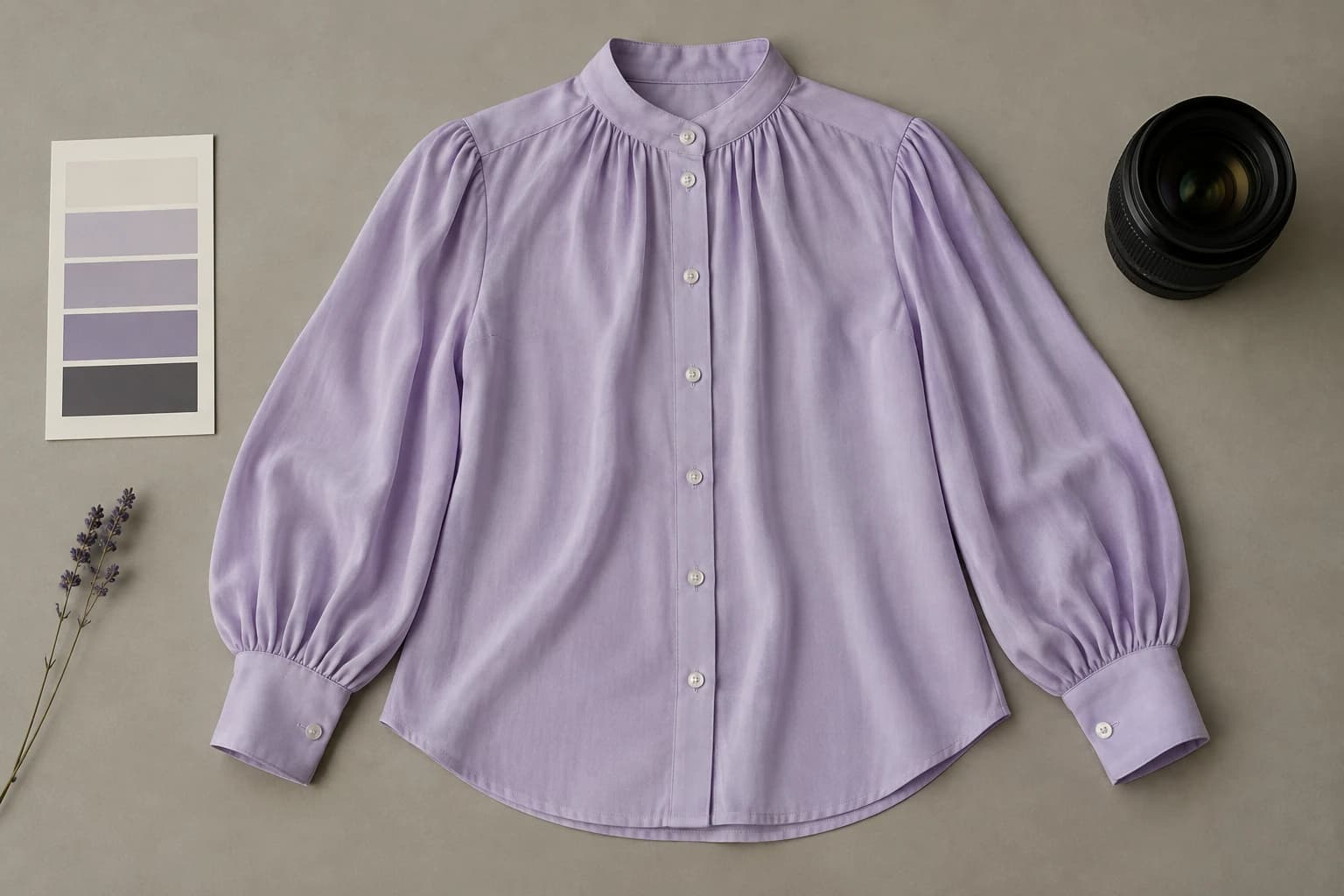
List the product features that must survive unchanged and the visual features that may vary. For example, a hypothetical shirt task could permit a different background while requiring the collar, placket, sleeve length, and stripe spacing to match the reference. State whether the image is for a campaign concept, an advertisement, or a product gallery.
Give reviewers a consistent decision: approve, revise, or reject, with a reason. A visually appealing but inaccurate output should not be counted as a success. Track approved images separately from generated images so that production planning reflects the assets the team can actually use.
Budget the whole process
Measure preparation, generation, review, correction, export, and any fallback photography. Include failed attempts. A low price per output can coexist with a high cost per approved asset if the team spends a long time repairing each result. Conversely, a more expensive generation route may be useful if it reliably reduces a difficult review burden.
Keep a retry rule. After a repeated garment error, a better source photograph or a different production method may be more useful than another minor prompt change. Record the point at which the team changes approach. This protects the schedule and produces clearer information about what the workflow can handle.
Expand only where the evidence travels
Review the test by product type and task. Success with a plain shirt does not establish success with lace, reflective hardware, transparent fabric, or a precise printed graphic. Build a short list of supported tasks and a separate list of tasks that still need evaluation. This makes expansion deliberate rather than an assumption.
For each new category, run a smaller version of the same test. Keep the acceptance criteria stable enough to compare results, but add checks for the new garment's distinctive features. Document any change in the tool or model used; a later software update may alter the behavior that the original test established.
A dependable workflow includes a fallback. Preserve accurate source photography and identify who can approve its use if a generated version misses the deadline or the standard. The objective is a reliable content operation. AI earns a place in that operation through useful, repeatable results that survive ordinary production conditions.