A practical operating brief for reviewing, approving, and delivering fashion images when your team works across locations.
The starting point
A good fashion image rarely travels straight from camera to storefront. It passes through a founder's phone, a photographer's folder, a merchandiser's comments, and a designer's export settings. Each handoff can introduce a different crop, an unclear correction, or a file that looks approved but is still a draft. Before adding another application, make those handoffs visible.
Think of mobility as a workflow requirement. A person should be able to identify the right garment, understand the image's intended use, and leave an unambiguous decision wherever they work. That does not mean every task belongs on a phone. Colour judgement, detailed retouching, and comparison against a physical sample may need a more controlled setup.
Give every image a job
Start with three fields: product identifier, destination, and decision owner. “Jacket image” is too vague. “JK104, product gallery front view, approved by merchandising” tells the next person what they are looking at. Add a version number to the filename and keep the source image alongside the derived output. A screenshot sent through chat should never become the only surviving reference.
For a hypothetical four-person label, the founder might approve campaign tone while the merchandiser approves garment accuracy. Both decisions matter, but they answer different questions. Record them separately. Otherwise a beautiful composition may be treated as permission to publish an incorrect pocket, or an accurate product view may be rejected because it was judged against an advertising brief.

Design the review before producing the batch
Use three review states: changes needed, approved for the named destination, and archived. Avoid an ambiguous “looks good” response. A correction should identify the location and desired result: “Keep the original two-button cuff visible” is actionable; “make it more premium” is not. Collect related corrections into one pass rather than sending a new message for each detail.
Make a small approval board with a source column, a candidate column, and a comment column. Review the first representative item before expanding to the collection. Include a difficult garment early: a fine stripe, a reflective fabric, or an unusual closure. This exposes weak points while the cost of changing direction is still manageable.
Separate quick checks from final checks
A mobile review works well for framing, missing files, obvious garment errors, and campaign consistency. Final delivery needs the destination's actual dimensions, an inspection at usable resolution, and a check that the downloaded file matches the approved candidate. Assign that final check to one named person, even when several colleagues contributed earlier feedback.
Connection quality also belongs in the plan. Keep uploads resumable where the chosen tools support it, preserve originals until delivery is confirmed, and document how a failed transfer is retried. Do not rely on a chat attachment as the archive. The practical test is simple: could another teammate recover the latest approved image without asking its creator?
Run a one-drop rehearsal
Before redesigning your entire operation, take one small product drop through the proposed sequence. Note where people wait, where they repeat explanations, and where versions become confusing. Count approved, usable assets rather than files generated. Then remove one avoidable handoff and repeat the exercise.
Your workflow is ready to travel when context travels with it. The image, its product reference, its approval history, and its intended destination should stay connected. That foundation matters more than whether the team is reviewing from a studio desk, a warehouse, or the train home.
Research & sources
These findings describe the named studies and companies. They provide context, rather than measuring Atellia or establishing the effect of the advice above. Source dates are separate from retrospective theme years.
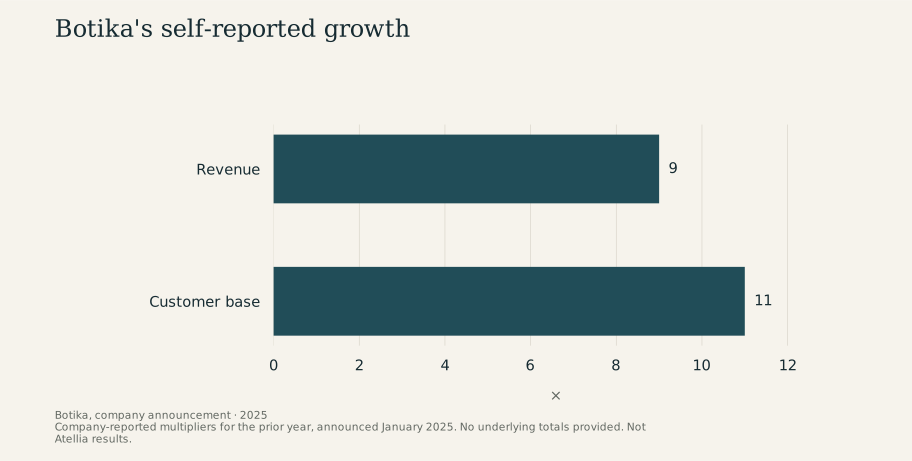
Botika's self-reported growth
2025 · ×
View chart data
| Measure | × |
|---|---|
| Revenue | 9 |
| Customer base | 11 |
Study scope and numerical references
- Botika announced seed funding: 8 USD million. Company announcement, January 2025; not Atellia funding. Botika, company announcement, 2025
- Botika reported revenue growth: 9 multiple. Botika's preceding-year statement; baseline not disclosed. Botika, company announcement, 2025
- Botika reported customer-base growth: 11 multiple. Botika's preceding-year statement; baseline not disclosed. Botika, company announcement, 2025