Use a limited image trial to evaluate garment fidelity, usable exports, and the complete cost of a production workflow.
The starting point
A free image trial is most useful when it answers a question you would otherwise pay to resolve. Can the tool preserve a particular print? Can it produce a usable crop for your shop? Can a teammate review the result without a lengthy handoff? Choose the question before spending the trial allowance. A folder of attractive experiments may leave the commercial decision just as uncertain.
Prepare a small but revealing test
Choose a straightforward garment and a more demanding one from your own catalog. Use source photographs that you have the right to process. Include clear views of the features you want the output to preserve. A weak source image can make it difficult to tell whether the tool or the input caused a problem.
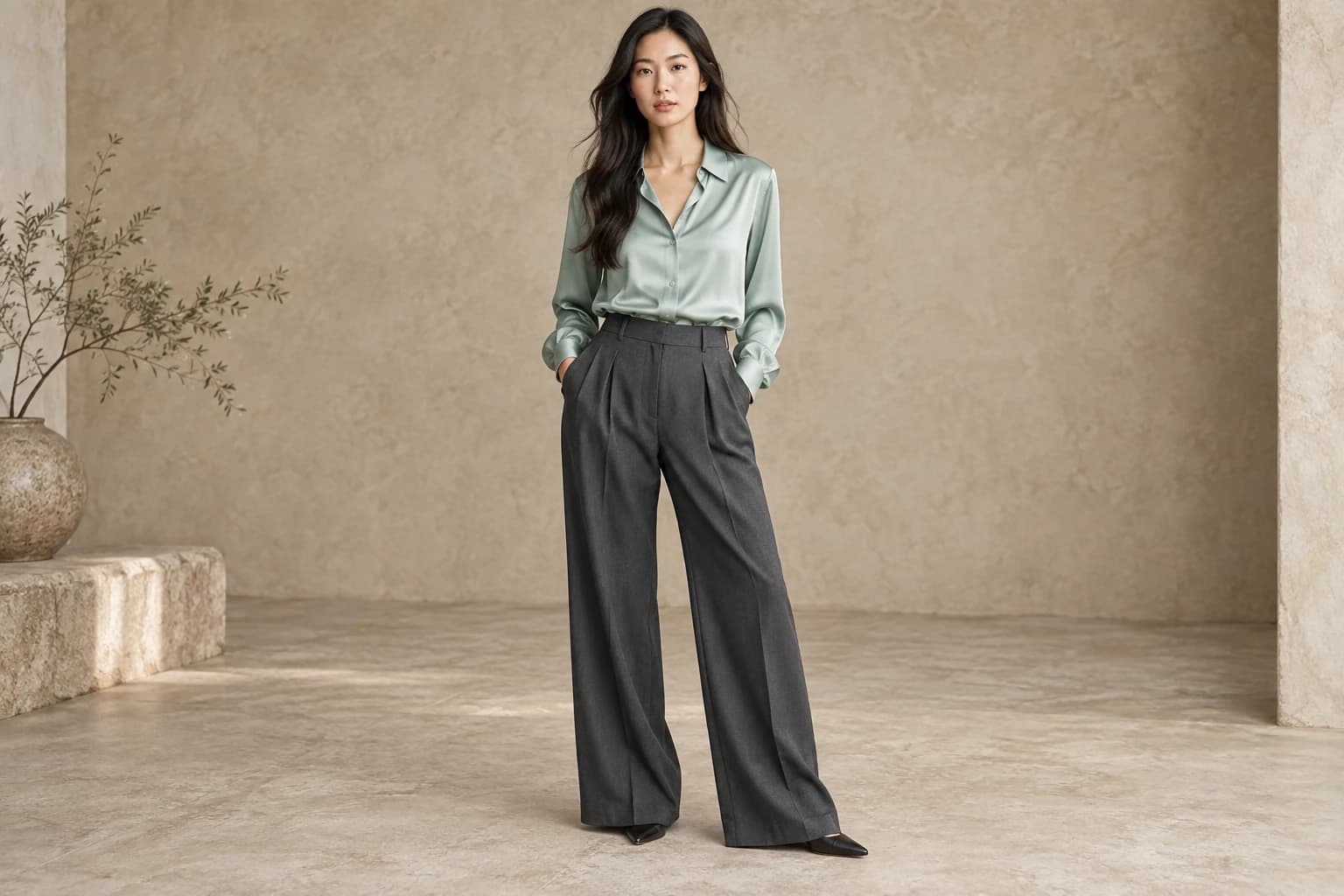
Write the intended placement beside each test. A small campaign concept and a product-gallery hero require different scrutiny. For a hypothetical printed blouse, the key question might be whether the pattern and neckline remain accurate in a standing composition. That is more useful than asking whether the output looks generally realistic.
Inspect what the free tier actually delivers
Check the export dimensions, visible marks, available formats, and the terms relevant to your intended use. Review the current product information rather than assuming that free and paid outputs have identical conditions. Record what you can verify and what remains unclear. This guide does not describe a particular Atellia allowance or promise a specific paid feature.
View the exported file, not only the preview inside the application. Open it at the size needed for the final placement and inspect garment details closely. A pleasing thumbnail can conceal a distorted seam or softened pattern. If the trial prevents a meaningful inspection, treat that as a limit of the evaluation rather than evidence of production readiness.
Count approval effort
Record attempts, review time, corrections, and approved outputs. Do not divide the subscription price by the theoretical maximum number of generations and call that the cost per usable image. The relevant denominator is the number that passes your standard. Preparation and human review belong in the estimate too.
Pay particular attention to errors that could change a purchase decision. Missing closures, different lengths, or an altered fabric appearance deserve rejection even if the rest of the image is convincing. Retain accurate product photography as a reference and as a practical fallback for garments the workflow cannot handle.
Use outside statistics with their proper scope
The National Retail Federation and Happy Returns projected total U.S. retail returns of $849.9 billion in 2025. That estimate describes returns across retail; it does not identify inaccurate fashion images as the cause or prove that a particular image tool reduces returns. Its useful lesson for this trial is to take product representation seriously, then measure your own outcomes. Source: NRF's 2025 Retail Returns Landscape.
Finish the trial with a short decision record: the tasks that worked, the failures, the paid conditions still to confirm, and the next experiment if the evidence is promising. A limited trial does not need to produce a complete campaign. It needs to leave you better able to decide whether the workflow belongs in your business.
Research & sources
These findings describe the named studies and companies. They provide context, rather than measuring Atellia or establishing the effect of the advice above. Source dates are separate from retrospective theme years.
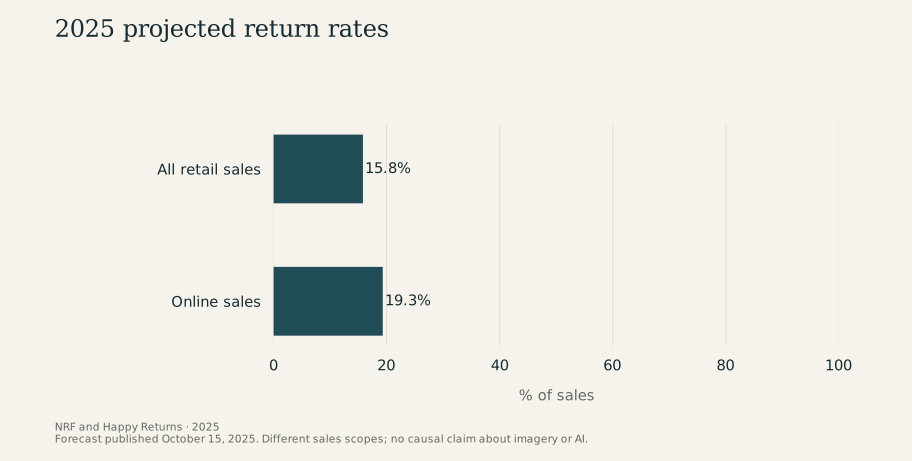
2025 projected return rates
2025 · % of sales
View chart data
| Measure | % of sales |
|---|---|
| All retail sales | 15.8 |
| Online sales | 19.3 |
Study scope and numerical references
- Projected total U.S. retail returns: 849.9 USD billions. October 2025 forecast, U.S. retail across channels; not a measured fashion-only total NRF and Happy Returns, 2025
- Estimated share of annual retail sales returned: 15.8 percent. 2025 retailer estimates NRF and Happy Returns, 2025
- Estimated share of online sales returned: 19.3 percent. 2025 online sales estimates NRF and Happy Returns, 2025