Translate an industry-scale generative-AI forecast into a bounded, measurable experiment for a fashion business.
The starting point
Industry forecasts can make generative AI feel like an urgent strategic decision. A fashion founder still needs a much smaller answer: which task should the team try, and what would count as useful progress? Start with a recurring problem that has a clear owner and a reviewable result. The first experiment should produce learning the business can act on.
Read the opportunity at the right scale
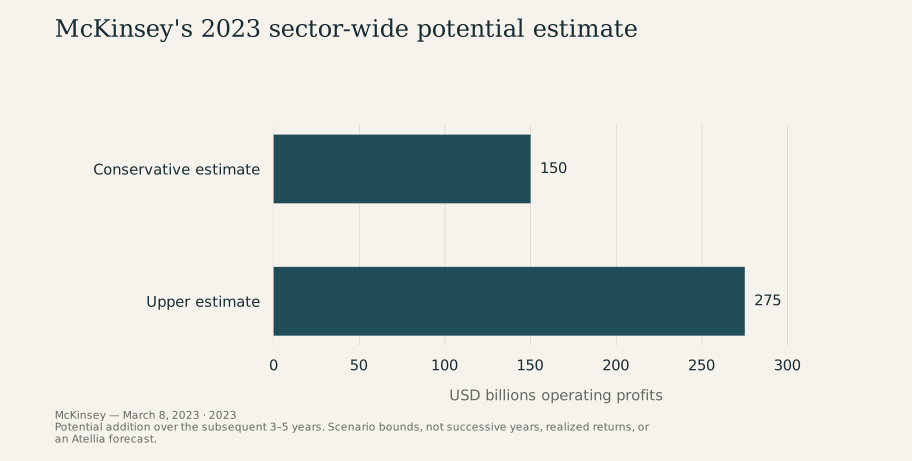
In March 2023, McKinsey estimated that generative AI could add between $150 billion and $275 billion to operating profits across apparel, fashion, and luxury over the following three to five years. That was a sector-wide potential estimate, not a realized outcome or a revenue forecast for an individual brand. Source: McKinsey's 2023 analysis.
The useful response to that kind of research is to identify where the technology might affect your own work. Keep the external estimate in a context section and build the business decision from local evidence. A large market number does not establish which tools, tasks, or operating changes will work for your assortment.
Choose a problem with an observable result
List repeated tasks that consume time or create delays. Examples might include organizing product notes, developing early campaign concepts, or preparing draft copy from approved facts. Rank them by the clarity of the desired output and the team's ability to check it. A task with an understandable review standard makes a better first experiment than a vague ambition to transform marketing.
For a hypothetical small label, the first test could be drafting collection copy from a structured product sheet. The reviewer would check every material, construction, and availability claim. The experiment would measure preparation and review effort as well as writing time. That gives the team a complete view of the change.
Keep the experiment bounded
Use a defined product set, a fixed task, and an agreed acceptance standard. Decide which source information may be used and who approves the result. Maintain a way to complete the work with the existing process if the test fails. This lets the team explore without making the launch depend on an unproven method.
For image tasks, distinguish concept exploration from product-ready presentation. An appealing generated scene can be useful even when it is unsuitable as evidence of an actual garment. Label the intended use and inspect any product representation against approved references. Do not count an attractive but inaccurate output as a completed product asset.

Make the next decision explicit
At the end of the test, compare approved outputs, total effort, failure types, and any operational friction. Ask what improved and what new work appeared. The answer may support a narrow adoption, another experiment, or a decision to stop. Each is a useful outcome if the evidence is clear.
Avoid expanding from one successful example to a claim about the whole business. A copy task does not validate image production; a simple garment does not validate intricate embroidery. Carry the review method into the next experiment and let the scope grow only where the evidence supports it.
The strongest first step is modest enough to inspect and important enough to matter. It gives the brand a repeatable way to learn, rather than another slide about the size of the opportunity. Strategy becomes more concrete when the team can name the task, show the result, and explain the decision that follows.
Research & sources
These findings describe the named studies and companies. They provide context, rather than measuring Atellia or establishing the effect of the advice above. Source dates are separate from retrospective theme years.
McKinsey's 2023 sector-wide potential estimate
2023 · USD billions operating profits
View chart data
| Measure | USD billions operating profits |
|---|---|
| Conservative estimate | 150 |
| Upper estimate | 275 |
Study scope and numerical references
- Conservative estimate of potential additional operating profits: 150 USD billions. March 2023 scenario across apparel, fashion and luxury over the following three to five years McKinsey, 2023
- Upper estimate of potential additional operating profits: 275 USD billions. March 2023 sector-wide potential, not realized outcomes McKinsey, 2023