
Connect an AI investment to a specific recurring task, a measurable outcome, and a named person responsible for quality.
The starting point
Large claims about generative AI can make a small operational problem seem too ordinary to discuss. Yet the ordinary problem is often the right place to begin. A missing product description, a slow image approval, or a folder nobody can navigate creates work every week. A useful investment should change that work in a way the team can observe.
Write a job description for the proposed system. State the task, the inputs it can use, the output it should produce, and the decisions it cannot make alone. This turns an open-ended technology purchase into an operating brief that a colleague can question and improve.
Name the person whose week should improve
Choose one role and describe a real recent situation. Perhaps a merchandiser spent an afternoon turning approved product notes into a consistent format. Perhaps a creative lead repeated the same crop instructions across many assets. Be specific about the task and the surrounding constraints.
Talk to the person doing the work before choosing the tool. They may explain that the apparent drafting problem is actually missing product information, or that the image delay comes from unclear approvals. In those cases, better inputs or ownership may matter more than generation quality.

Define a useful result and an unacceptable one
A useful result should be inspectable. For a hypothetical catalogue task, it might be a completed set of draft descriptions with all approved materials and care details preserved. An unacceptable result might contain invented composition, inconsistent product names, or unsupported performance claims.
Give the reviewer a way to mark uncertainty. A system that signals a missing fact is easier to manage than one that fills every field confidently. Keep the original source available so corrections can be made against evidence rather than memory.
Budget for adoption, not just access
The subscription or usage fee is only part of the commitment. Someone must prepare inputs, learn the workflow, review outputs, document exceptions, and keep the process current. Include those tasks in the pilot plan. A tool that looks inexpensive can still be a poor fit if it requires attention the team cannot spare.

Choose a limited trial with a clear finish line. Run one representative batch through the complete process and compare it with the existing method. Count accepted work and the effort required to reach acceptance. Avoid measuring only how quickly the first output appears.
Make the expansion decision explicit
At the end of the trial, review the evidence with the people affected. Decide whether to adopt, revise, or stop. Record what the result does and does not establish. A successful description-drafting pilot does not automatically justify automated publishing or a different image workflow.
If you adopt the process, assign an owner for maintenance. Product fields change, brand language evolves, and providers may update their behaviour. Keep an example of a correct output and a small set of difficult cases for periodic checks. The process needs a way to notice when its assumptions stop holding.
The ambition can remain large while the first decision stays practical. A clear job description makes it easier to spend deliberately, learn quickly, and protect the parts of the business that already work. The result is an operating improvement your team can explain, not simply a technology expense with a promising label.
Research & sources
These findings describe the named studies and companies. They provide context, rather than measuring Atellia or establishing the effect of the advice above. Source dates are separate from retrospective theme years.
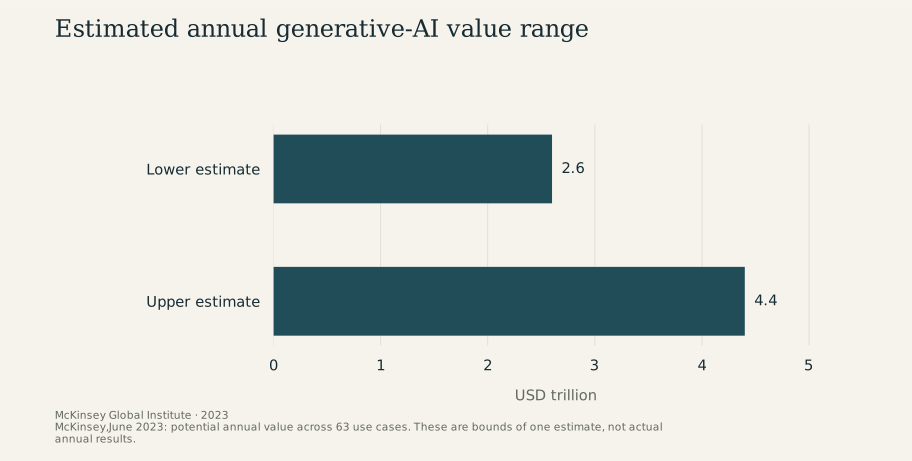
Estimated annual generative-AI value range
2023 · USD trillion
View chart data
| Measure | USD trillion |
|---|---|
| Lower estimate | 2.6 |
| Upper estimate | 4.4 |
Study scope and numerical references
- Estimated potential annual economic value: 2.6–4.4 USD trillion. 2023 scenario estimate across 63 use cases; potential, not observed value. McKinsey Global Institute, 2023