A 2025 retrospective lens for reading production savings and conversion claims without confusing a customer story with your own forecast.
The starting point
A case study can make a new workflow feel tangible. It shows a team, a problem, and a result. It can also compress a complicated business change into a few impressive numbers. When reviewing fashion AI stories from 2025, the useful question is what the account actually establishes and which details you would need before applying it to your own brand.
Treat the story as a starting point for inquiry. A result reported by another company may be accurate within its circumstances while offering little guidance about your catalogue, audience, or production process. The purpose of careful reading is to find the transferable lesson.
Find the original problem
Look for a description of the work before the change. Was the brand missing on-model imagery, waiting for samples, paying for frequent shoots, or struggling with corrections? Different problems create different opportunities. A large saving may reflect the removal of a specific expensive step rather than a general advantage that applies to every business.
Ask what the new workflow included. Did the team change its styling, product pages, campaign strategy, or approval process at the same time? Those details help explain the result. Without them, it is easy to attribute a broad operational improvement to one tool.
Read the denominator
A percentage needs a base. A production saving might compare supplier invoices while excluding staff review time. A conversion improvement might refer to a subset of products, a particular channel, or a short period. The statement becomes more useful when the scope is explicit.
For a hypothetical example, reducing a $1,000 external bill to $200 is an 80% reduction in that bill. It is not necessarily an 80% reduction in total production cost if preparation and review work changed. This example illustrates the calculation only; it is not a customer result or an Atellia performance claim.
Distinguish a testimonial from an experiment
A customer can sincerely report that sales improved after adopting a workflow. That account is different from a controlled experiment that isolates the effect of a particular image change. Look for information about comparison groups, timing, traffic, stock availability, and other changes that could affect the outcome.

If those details are absent, keep the conclusion modest. The story may demonstrate that a team found the workflow useful, while leaving the size and cause of the commercial effect uncertain. Do not convert a testimonial into a guaranteed forecast for your own store.
Turn the story into a pilot question
Choose one aspect worth testing locally. If the case study describes faster image turnaround, measure turnaround on one representative product batch. If it describes better catalogue coverage, define the missing views in your own range and evaluate whether the process fills them accurately.
Set the acceptance criteria and the cost boundary before the pilot. Include difficult garments and a correction round. Record the review effort alongside the number of approved assets. This gives the team evidence that belongs to its own operation.
Keep public examples as context, clearly attributed to the companies involved, and keep your results separate. The strongest lesson from a retrospective is a sharper set of questions for the next decision. A compelling story earns attention; a well-designed local test earns a place in the operating plan.
Research & sources
These findings describe the named studies and companies. They provide context, rather than measuring Atellia or establishing the effect of the advice above. Source dates are separate from retrospective theme years.
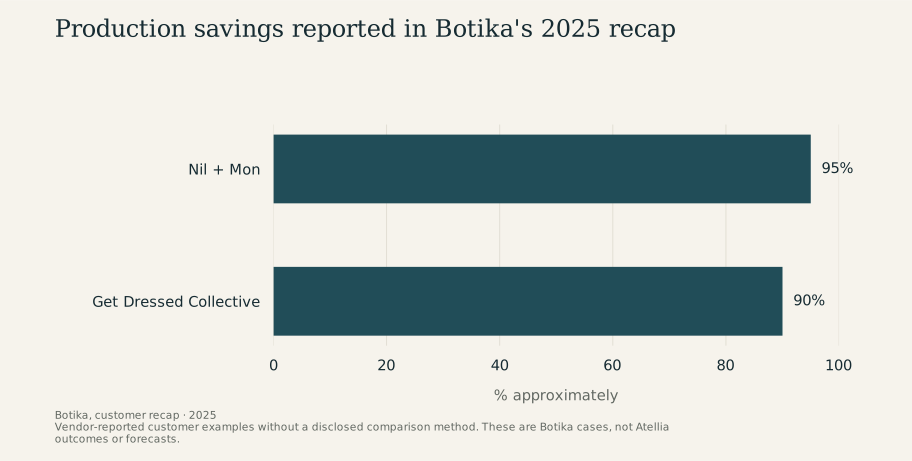
Production savings reported in Botika's 2025 recap
2025 · % approximately
View chart data
| Measure | % approximately |
|---|---|
| Nil + Mon | 95 |
| Get Dressed Collective | 90 |
Study scope and numerical references
- Nil + Mon production-cost saving reported by Botika: 95 % approximately. Botika 2025 recap; methodology and baseline not supplied. Botika, customer recap, 2025
- Nil + Mon conversion multiplier reported by Botika: 3–4 ×. Botika 2025 recap; attribution not independently established. Botika, customer recap, 2025
- Get Dressed Collective cost saving reported by Botika: 90 % approximately. Botika 2025 recap; methodology and baseline not supplied. Botika, customer recap, 2025