Plan a focused creator collaboration with a usable brief, an explicit deliverable list, and a measurement plan that fits a small brand.
The starting point
A first creator partnership should answer one useful question: can this person explain your product to an audience that might genuinely want it? Follower count alone cannot answer that. Before contacting anyone, choose a single product, a specific customer problem, and the kind of content that could demonstrate the answer. This keeps a modest collaboration from becoming an unfocused brand campaign.
Look for an editorial fit
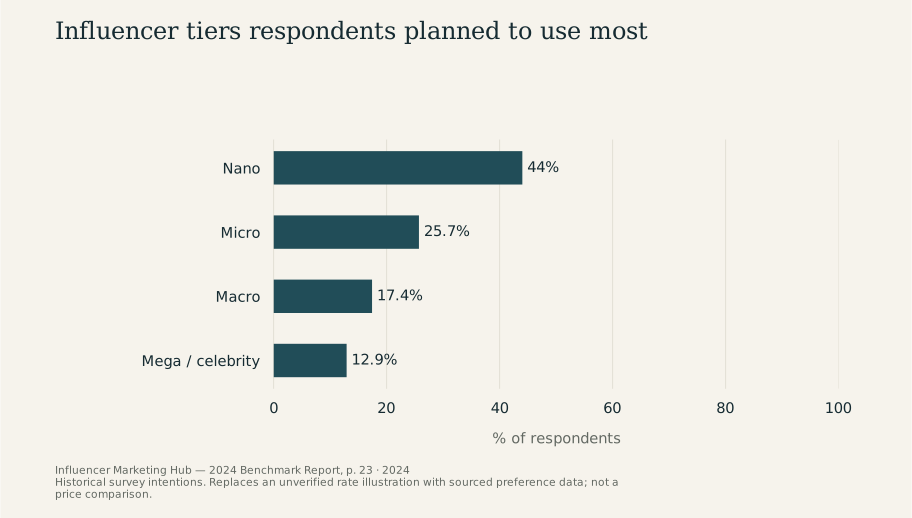
A historical reference can help frame the shortlist: Influencer Marketing Hub’s 2024 benchmark report recorded nano creators as the intended main influencer type for 44% of respondents, followed by micro creators at 25.7%, macro at 17.4%, and mega or celebrity creators at 12.9%. These are survey preferences, not a rate card or a prediction of your results. Source: 2024 benchmark report, page 23.
Read the creator's recent work as you would read a magazine. What questions do they answer? What details do they notice? How do they discuss sizing, price, materials, or repeat wear? Look at the substance of audience comments rather than just the totals. A small audience asking detailed wardrobe questions may be more relevant than a large audience responding only to the setting.
Build a shortlist with a short written reason for each choice. For a hypothetical travel trouser, one creator might explain packing and another might show office-to-evening styling. Those are different editorial assignments. Avoid sending both an identical demand for a generic unboxing; it would waste the reason you selected them.
Write the brief around a demonstration
Give the creator accurate product information, the intended audience, and the question the content should answer. Include details that must remain correct, such as fabric composition, available sizes, and care instructions. Separate these facts from suggested talking points. Leave room for the creator's own observations, including honest limitations discovered when wearing the garment.
Define the deliverables in plain language: the number of pieces, approximate format, where they will appear, review stages, delivery dates, and whether source files are included. Discuss compensation, disclosure, and any reuse or paid-media permissions explicitly. A post on someone's account and a license to run their face in an advertisement are different uses; record what has actually been agreed.
Make feedback narrow and useful
Use review time to correct factual errors and flag agreed production requirements. Do not ask the creator to disguise an advertisement as an independent discovery or to describe an experience they did not have. If an opinion does not suit the brand, discuss the disagreement directly rather than rewriting it into a testimonial. The long-term asset is credible communication.
Provide one consolidated round of feedback from one brand contact. Notes such as 'show the inside pocket while describing it' help the creator act. Notes such as 'make this more premium' usually need a visual example or a clearer explanation. If the original brief missed something important, acknowledge the change and discuss its effect on the schedule.
Review the partnership as a small experiment
Choose measurement before publication. A distinct landing page or tagged link can help separate visits from the partnership, while a customer question at checkout can add context. Review content quality, relevant audience responses, qualified visits, and downstream sales together. Do not attribute every later order to the collaboration or assume that all useful effects appear immediately.
Hold a short debrief with the creator. Ask what their audience understood, what required more explanation, and which production step caused friction. Keep the best learning even if the first commercial result is modest. A useful first partnership leaves you with a stronger brief, clearer product language, and a reasoned decision about whether to work together again.
Research & sources
These findings describe the named studies and companies. They provide context, rather than measuring Atellia or establishing the effect of the advice above. Source dates are separate from retrospective theme years.
Influencer tiers respondents planned to use most
2024 · % of respondents
View chart data
| Measure | % of respondents |
|---|---|
| Nano | 44 |
| Micro | 25.7 |
| Macro | 17.4 |
| Mega / celebrity | 12.9 |
Study scope and numerical references
- Respondents planning primarily to use nano influencers: 44 percent. 2024 benchmark survey; intended influencer tier preference, not compensation or performance Influencer Marketing Hub, 2024