Read resale market projections with their dates and scope intact, then translate them into practical questions about your own assortment.
The starting point
A large market forecast can make a business decision feel obvious. It rarely tells you which garments your customers will resell, what condition they will be in, or what operating model would suit your brand. Use the forecast as context, then work through the product and customer questions that sit between an industry estimate and a practical resale program.
Keep the forecast attached to its date
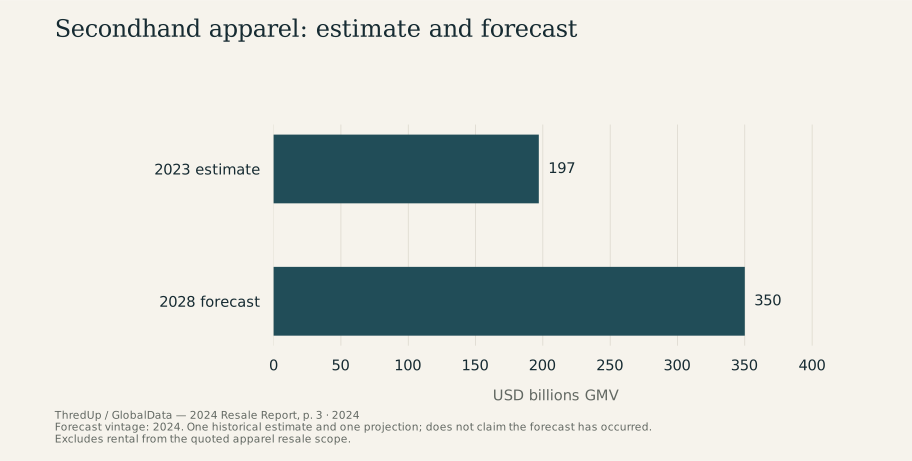
The same report estimated 2023 global secondhand apparel gross merchandise value at $197 billion. A comparison with the $350 billion forecast should label one as an estimate for a past year and the other as a projection. It is not a record of growth already achieved. Source: original report, page 3.
ThredUp's 2024 Resale Report projected that the global secondhand apparel market would reach $350 billion by 2028. That is a forecast published in 2024, not a measurement of 2028 sales or a current guarantee. Its scope is secondhand apparel, and it should not be silently expanded to every circular business model. Source: ThredUp's 2024 Resale Report.
When using a market number in a presentation, write the publication year, target year, geography, category, and whether it is observed or projected. Those labels make the number more useful. A chart that hides them can imply certainty or relevance that the underlying research does not provide.

Start with the product after its first owner
Inspect a selection of garments that have actually been worn. What holds up? What needs repair? Which labels or construction details help identify the item later? A resale concept depends on the condition and recognizability of physical products, not just the attractiveness of a market-growth curve.
For a hypothetical denim label, the team might find that durable styles are easy to identify while seasonal treatments require more careful condition descriptions. That observation could shape intake guidelines and photography. It would not establish that every item should enter resale or that the program will be profitable.
Make condition legible
Secondhand product imagery should show the actual item being sold. Record wear, repairs, discoloration, or missing components clearly. Attractive presentation can coexist with precise condition photography. Avoid using a generated image that removes the characteristics a buyer needs to evaluate, even if the original garment design appears correct.
Create a consistent sequence: whole item, reverse, identifying details, and any condition-specific views. Pair the pictures with a defined condition vocabulary. Test the vocabulary on a few examples with several reviewers; if they assign different grades to the same garment, the system needs clearer descriptions before scaling.

Evaluate the operating model on its own terms
Map collection, inspection, cleaning where relevant, repair, photography, storage, fulfillment, and customer support. Identify who owns each step and what happens to rejected stock. Market demand does not remove the cost or complexity of those activities. A small pilot can reveal which assumptions need better evidence.
Choose a practical learning goal for the pilot. It might be determining whether customers can understand the condition categories or whether the intake process produces enough sellable items. Keep commercial measurements separate from environmental claims. A resale transaction does not by itself quantify an avoided purchase or a reduction in emissions.
Return to the market forecast after the pilot. It can support a discussion about the broader category, while your own evidence supports the operating decision. That separation lets a founder be ambitious without confusing a large external opportunity with proof that a particular program is ready to grow.
Research & sources
These findings describe the named studies and companies. They provide context, rather than measuring Atellia or establishing the effect of the advice above. Source dates are separate from retrospective theme years.
Secondhand apparel: estimate and forecast
2024 · USD billions GMV
View chart data
| Measure | USD billions GMV |
|---|---|
| 2023 estimate | 197 |
| 2028 forecast | 350 |
Study scope and numerical references
- Estimated global secondhand apparel GMV: 197 USD billions. Page 3; historical market estimate, not rental-market revenue ThredUp / GlobalData, 2024 Resale Report, 2023
- Forecast global secondhand apparel GMV: 350 USD billions. Page 3; projection published 2024, not achieved revenue ThredUp / GlobalData, 2024 Resale Report, 2028